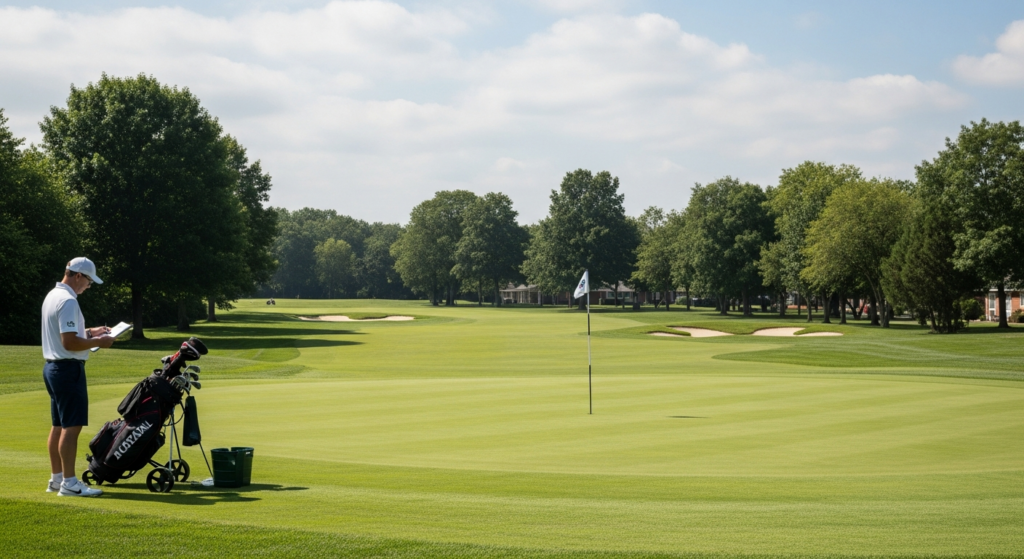
Golf courses across the region, including those in Lexington, operate under a blend of formal regulations and unwritten customs designed to ensure fair play, maintain course integrity, and promote safety for all participants. Adhering to these principles is not merely a matter of courtesy but a fundamental aspect of the game, contributing to a more enjoyable experience for everyone on the course.
At the heart of golf lies basic course etiquette, which dictates how players interact with their environment and fellow golfers. This includes avoiding any movement, talking, shouting, or other potential distractions while another player is preparing to take a shot. Players should also refrain from walking in front of a player who is about to hit, and always remain outside their line of sight. On the putting green, it is particularly important to avoid stepping on another player’s putting line or casting a shadow that might interfere with their concentration. After a round or match concludes, a customary gesture of sportsmanship involves removing one’s cap and shaking hands with opponents and playing partners, acknowledging the competition and camaraderie.
Maintaining an appropriate pace of play is another critical component of golf etiquette. Slow play can detract significantly from the enjoyment of others on the course. Golfers are encouraged to keep pace with the group ahead, rather than simply staying ahead of the group behind. Planning the next shot while walking to the ball, and playing ‘ready golf’—where players hit when they are ready, rather than strictly adhering to who is ‘farthest out’ (except in match play)—can help expedite rounds. Once a group has finished putting, they should clear the green promptly, moving their bags or trolleys to the next teeing area to allow the following group to approach. If multiple balls are lost, players should split up to search, and if a ball is clearly lost, it’s often more efficient to drop a new ball with a penalty rather than prolonging the search. When a faster group is waiting, allowing them to play through is a common courtesy. Some courses, for instance, may designate specific holes, like an 8th hole, as a ‘call-up’ hole where a group on the green, not yet putting, should wave the waiting group on the tee through before finishing their own play.
Protecting the course is a shared responsibility that ensures the longevity and quality of the playing surface. This involves several key actions: always repairing pitch marks on the greens, replacing divots on fairways, and using grass seed provided (rather than replacing turf) to repair divots on tee boxes. Bags and trolleys should be kept off tee boxes and greens to prevent damage. During specific conditions, such as winter, players must adhere to white lines and arrows indicating areas to avoid, and use winter wheels on trolleys if requested. When retrieving a ball from the hole, it should be lifted by hand, not scooped out with a putter, which can damage the cup’s edge. Using designated steps or paths instead of walking on banks helps prevent erosion. Players should also take free drops from ground under repair or the wrong green as specified by local rules, and always follow signage regarding the use of buggies and trolleys.
Accurate ball identification is crucial to avoid penalties and maintain the integrity of the game. Before teeing off, golfers should mark their ball with a distinctive pattern or initials and declare which ball they are playing. If a provisional ball is hit, it must also be distinguishable from the original ball, and its provisional status declared. Always check the ball to confirm it is yours before playing it. Playing the wrong ball results in a two-stroke penalty in stroke play or loss of hole in match play, requiring the player to replace their original ball where it was. It’s generally advisable to leave spare balls alone unless they are certainly lost.
Safety on the golf course is paramount. Before taking a practice swing, players must check that no one is standing behind them. Shots should only be taken when golfers, walkers, and spectators are well out of range. When observing another player, stand at least two club lengths away. Special attention should be paid to cross-over holes where fairways intersect, and players must ensure the group ahead is clear before teeing off, particularly on holes like the 5th, which might have blind spots. If a ball is hit and appears to be heading towards someone, or disappears from view in a direction where it might hit someone, the player must immediately and loudly shout “Fore!” Conversely, upon hearing “Fore!,” golfers should duck and cover their heads to protect themselves.
Understanding common rules issues and dress codes further enhances the golfing experience. For a lost or out-of-bounds ball, if no provisional was played, the player must replay from the previous position with a one-penalty stroke. Generally, a ball should not be lifted or cleaned unless under specific winter rules on the fairway or when it is on the green. In bunkers, players must not touch the sand before taking a shot. For an unplayable ball, a player can take a drop within two club lengths, no nearer the hole, for a one-penalty stroke. It is also forbidden to improve one’s lie or swing by treading down live vegetation or moving branches. Regarding dress, most courses prohibit jeans, sports shorts, rugby or football tops, sponsor tops, and generally sleeveless or collarless tops. Tailored shorts and golf-designer shirts are usually permitted. Golf shoes are typically restricted to the stud bar or patio areas, and caps and hats are generally not allowed in the clubhouse, except for specific events like a Christmas lunch. Mobile phones should be kept silent or switched off to avoid disturbing others.
Ultimately, the most important rule is to enjoy the game. When in doubt about any rule or etiquette, golfers should not hesitate to ask their playing partners or the clubhouse staff for clarification. A positive attitude and respect for the game’s traditions contribute to a welcoming atmosphere for all who step onto the greens in Lexington and beyond.
Why it matters in Lexington
Adherence to golf etiquette and course management principles is vital for the recreational landscape of Lexington. With facilities like the Lexington County Recreation & Aging Commission providing various community programs, and the presence of numerous private and public courses in the surrounding area, maintaining high standards of play and course care directly impacts the quality of life for many residents. These guidelines ensure that local courses remain in excellent condition, preserving valuable recreational assets for families, students, and retirees alike. By fostering a culture of respect and responsibility on the greens, Lexington reinforces its commitment to accessible and enjoyable outdoor activities, which contributes to the overall appeal and community spirit of the town. This collective commitment helps sustain the long-term viability and attractiveness of golf as a recreational pursuit within Lexington County.