

News Summary
The South Carolina Supreme Court is examining a vital lawsuit regarding alleged partisan gerrymandering in the state’s congressional maps. Initiated by the League of Women Voters, the case asserts that the maps dilute Democratic voting power and violate the state Constitution. The American Civil Liberties Union has joined the plaintiffs, stressing the importance of equitable representation. The outcome of this case could lead to significant changes in congressional boundaries ahead of the 2026 elections.
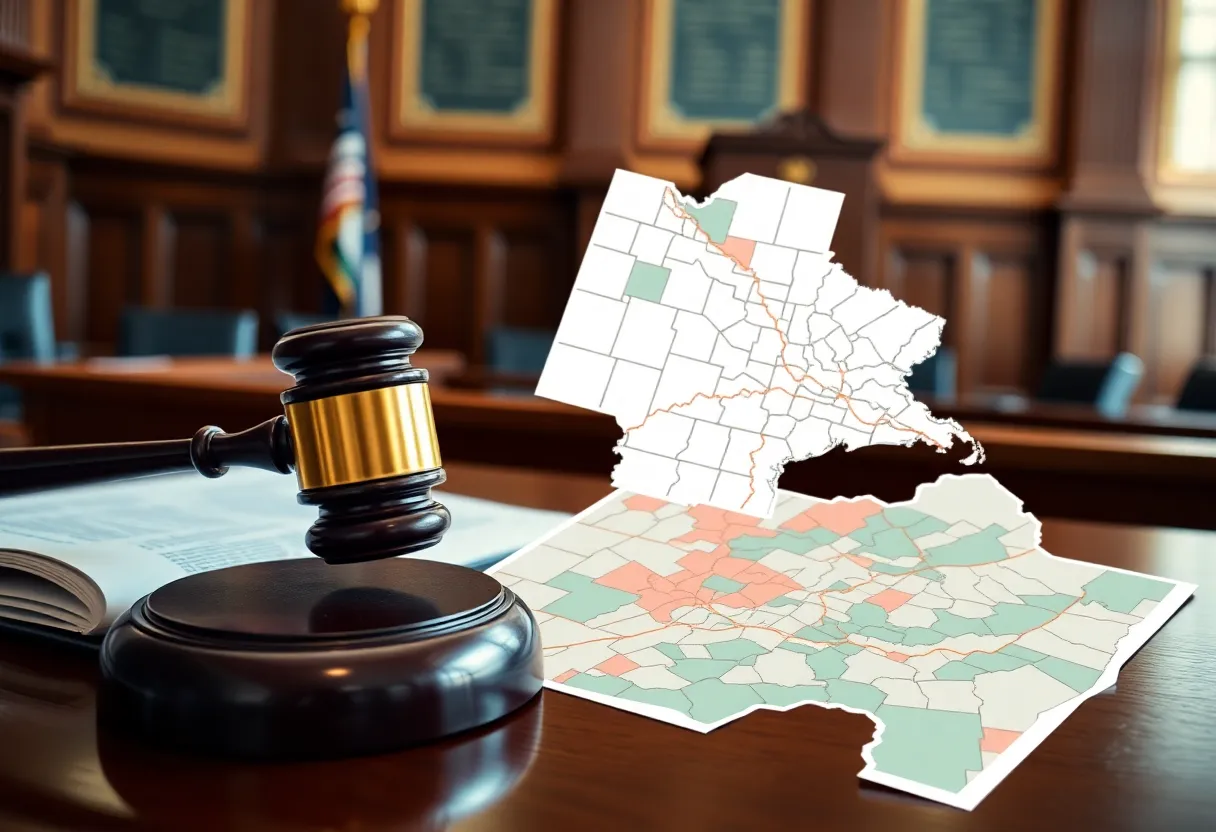
Columbia, South Carolina – The South Carolina Supreme Court is currently reviewing a significant lawsuit that challenges the state’s congressional maps over allegations of partisan gerrymandering. The lawsuit, initiated by the League of Women Voters, claims that the maps unfairly dilute the voting power of Democrats and violate the state Constitution.
The ongoing case has emerged two years after the U.S. Supreme Court upheld South Carolina’s congressional maps against claims of racial bias. This latest challenge rests on the assertion that the state’s constitutional guarantee of equal rights in electing representatives prohibits partisan maneuvering in redistricting.
In their argument, the plaintiffs claim that the redrawn congressional maps allow for a systematic weakening of Democratic voter influence, asserting that the configurations of districts contravene the principle of equal representation as outlined in South Carolina’s Constitution. The lawsuit highlights prevailing legal interpretations from states like New Mexico, Kentucky, and Pennsylvania, where courts have found similar constitutional provisions to obstruct partisan gerrymandering.
Background of the Gerrymandering Allegations
Previous allegations regarding the redistricting process spotlighted actions taken primarily by Republican lawmakers, who had been said to target Democratic voters while denying any claims of racial gerrymandering. Central to the dispute, it was disclosed that lead cartographer for Senate Republicans, Will Roberts, intentionally crafted districts that would favor Republican candidates.
The Senate Majority Leader also acknowledged that partisan interests were a central factor in the map-drawing process. The 2021 maps were the first constructed following the U.S. Supreme Court’s reversal of a requirement for federal pre-approval of congressional maps, raising fresh concerns about transparency and fairness in the redistricting process.
Implications of the Lawsuit
The American Civil Liberties Union (ACLU) has joined the argument, stating that the current maps rob voters of significant electoral influence and urging the court to suspend upcoming congressional elections until just maps are established. The impending congressional election is scheduled for November 2026, underscoring the urgency of the court’s ruling.
The case emphasizes alterations within the 1st Congressional District, where redistricting shifted voters who had supported President Biden to adjacent Democratic strongholds. Presently, the district is represented by Republican Nancy Mace, who has witnessed her victory margins increase significantly since the maps were redrawn: from 1% in 2020 to nearly 17% in the 2024 election cycle.
Mapping Strategies and Voter Redistribution
Redistricting efforts under scrutiny involved moving an estimated 53,000 voters from the 6th District into the 1st District, while around 140,000 voters, including over 30,000 Black voters, were transferred from the 1st District to the 6th District. This tactical maneuvering is often referred to as ‘packing‘—a strategy that seeks to concentrate voters of a particular party in fewer districts to diminish their overall electoral significance.
Defense for the current congressional maps is being offered by Republican lawmakers, who argue that the original authors of South Carolina’s Constitution did not intend to prohibit partisan gerrymandering. State lawyers contended that the Supreme Court should resist stepping into political territories concerning redistricting, suggesting that voters resolve any disputes through the electoral process.
Future Considerations
Chief Justice John Kittredge indicated that the court requires clearer guidelines to determine the legality of redistricting in a way that avoids partisan bias. The ACLU’s representatives emphasized that ensuring every citizen’s vote carries weight is not inherently a political issue, irrespective of party affiliation.
The outcome of the proceedings could compel the state legislature to redraw congressional boundaries ahead of the 2026 elections, a decision that might transform the political landscape of South Carolina substantially. As the court continues deliberating, its final ruling may have far-reaching implications for electoral integrity and representation in the state.
Deeper Dive: News & Info About This Topic
HERE Resources
Additional Resources
- SC Daily Gazette: SC Supreme Court Weighs Constitutionality of GOP Gerrymandering
- The State: SC Supreme Court Hears Gerrymandering Challenge
- ABC News 4: ACLU Gerrymandering Case Oral Arguments
- Wikipedia: Gerrymandering
- Encyclopedia Britannica: Gerrymandering


Author: STAFF HERE LEXINGTON WRITER
The LEXINGTON STAFF WRITER represents the experienced team at HERELexington.com, your go-to source for actionable local news and information in Lexington, Fayette County, and beyond. Specializing in "news you can use," we cover essential topics like product reviews for personal and business needs, local business directories, politics, real estate trends, neighborhood insights, and state news affecting the area—with deep expertise drawn from years of dedicated reporting and strong community input, including local press releases and business updates. We deliver top reporting on high-value events such as Woodland Art Fair, Crave Food and Music Festival, and Railbird Festival. Our coverage extends to key organizations like Commerce Lexington and Blue Grass Community Foundation, plus leading businesses in education, manufacturing, and technology that power the local economy such as University of Kentucky, Toyota Motor Manufacturing, and Lexmark. As part of the broader HERE network, including HEREBowlingGreen.com and HERELouisville.com, we provide comprehensive, credible insights into Kentucky's dynamic landscape.