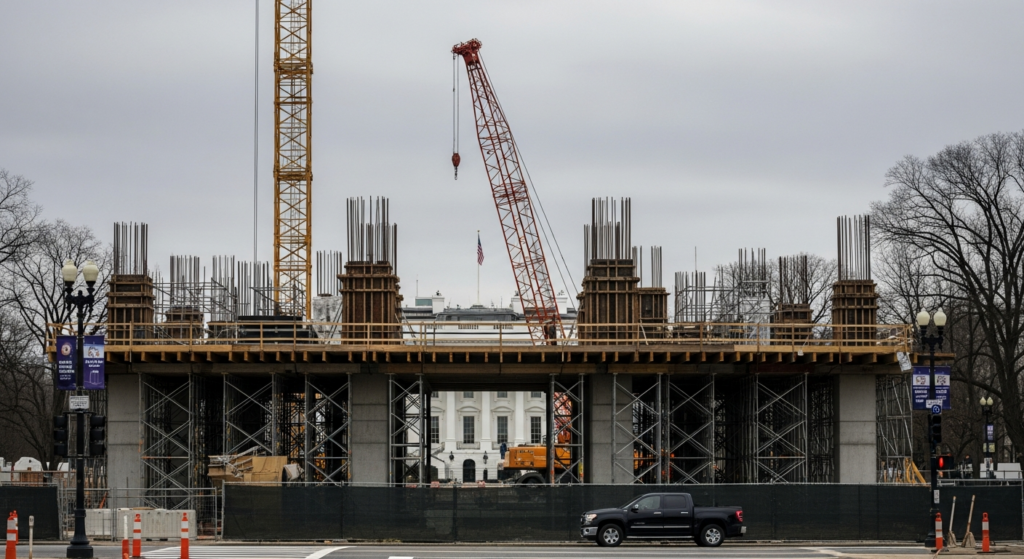
A divided federal appeals court panel has issued a significant ruling, ordering the Trump administration to cease construction on a proposed $400 million White House ballroom. The U.S. Court of Appeals for the District of Columbia Circuit, in a 2-1 decision, determined that the project cannot proceed without explicit congressional authorization, a requirement the administration has not met.
The ruling, handed down on Friday, August 7, 2026, by a three-judge panel, represents a victory for the National Trust for Historic Preservation, which initiated legal action against the project in December 2025. The organization’s lawsuit argued that the extensive undertaking, which involves replacing the demolished White House East Wing, required legislative approval that had not been secured. The East Wing, a historic component of the White House complex, was dismantled in the fall of 2025 to make way for the new facility.
The planned ballroom is an ambitious endeavor, envisioned as a 90,000-square-foot (8,400-square-meter) structure. Its proposed scale and cost have drawn scrutiny from both legal and legislative quarters. The appeals court’s decision specifically upholds an earlier order from U.S. District Judge Richard Leon, issued on April 16, which had already halted aboveground construction of the ballroom. Judge Leon’s initial ruling, however, permitted underground work to continue on a bunker and other national security facilities, distinguishing between the two components of the broader White House renovation plan.
The appeals court panel comprised Judges Patricia Millett, Bradley Garcia, and Neomi Rao. Judges Millett, an appointee of President Barack Obama, and Garcia, nominated by President Joe Biden, formed the majority in the decision to halt construction. Their opinion emphasized the necessity of congressional appropriation for projects of this magnitude, reinforcing the principle of checks and balances inherent in federal spending. Judge Rao, who was nominated by President Donald Trump, dissented from the majority, though the specifics of her dissenting opinion were not immediately released.
The administration has been granted a 14-day stay on the appeals court’s ruling, providing a window to appeal the decision to the U.S. Supreme Court. This period allows the executive branch to consider its legal options and potentially seek a reversal from the nation’s highest court, setting the stage for a further legal battle over the project’s future.
Congressional opposition to the ballroom project has been evident for months. In May, Congress explicitly rejected the administration’s request for $1 billion to fund the ballroom. This rejection highlighted a clear legislative intent to withhold funding for the project. Furthermore, in June, Democratic lawmakers raised concerns that $350 million from a recent tax cuts law appeared to have been redirected to White House security enhancements, including components related to the ballroom project. These allegations have fueled questions about the transparency and legality of the project’s funding mechanisms, reinforcing the National Trust for Historic Preservation’s argument that the project lacked proper authorization.
The legal challenge brought by the National Trust for Historic Preservation centered on the argument that the project, due to its scale and impact on a historic site, could not proceed without specific legislative approval. The organization contended that the demolition of the East Wing and the proposed construction of a new, massive ballroom fundamentally altered a nationally significant landmark, necessitating a higher level of oversight than the administration had sought.
The implications of this ruling extend beyond the immediate construction site. It reinforces the judiciary’s role in interpreting and enforcing constitutional provisions related to federal spending and the separation of powers. For the Trump administration, the decision presents a significant hurdle to a high-profile project, potentially forcing a reevaluation of its approach to funding and executing major federal initiatives. The ongoing dispute highlights the intricate balance between executive prerogative and legislative authority, particularly when it involves substantial public funds and alterations to national landmarks.
Why it matters in Lexington
The federal appeals court’s decision to halt the White House ballroom construction underscores the critical importance of legislative oversight and judicial review in the allocation of public funds and the execution of major government projects. In Lexington, where entities like the Lexington County Government and Lexington County School District One manage significant public budgets and undertake various infrastructure and development initiatives, these principles are equally fundamental. The precedent set by this national ruling, emphasizing adherence to established legal processes and congressional approval for large-scale spending, resonates with local governance. It highlights that even far-removed federal decisions can influence the broader regulatory and funding environment, impacting how public services and infrastructure projects are planned and executed within Lexington County. This case serves as a reminder of the checks and balances designed to ensure accountability in public spending, a principle vital at every level of government, including here in Lexington.